
The number of individuals claiming unemployment benefits declined by 32,300 to 1.59 million.

'The kind of situation we are seeing...we don't believe that this can happen in a settled democracy like India'

The Russia-Ukraine conflict, which has spooked financial markets globally, will set the tone for Dalal Street this week amid concerns over energy prices and foreign fund outflows, analysts said. Participants will also track key macroeconomic signals like GDP estimates and PMI data for manufacturing and services sectors to be announced this week, they added. "With earnings season behind us and given the overall sentiments, markets are expected to move in sync with global peers in the coming week. "A close eye will be kept on the developments concerning the Russia - Ukraine crisis and considering the inflation overhang, market participants will also observe movements in energy prices," said Shrikant Chouhan, Head of Equity Research (Retail), Kotak Securities Ltd.

Lawyers, doctors, accountants and other professional men are also consuming above average amounts of alcohol 20 units a week according to figures from the Office of National Statistics in UK.

The World Bank has retained India's economic growth forecast for the current fiscal at 8.3 per cent as the recovery is yet to become broad-based. As per the first advanced estimates of the national income released by the National Statistical Office (NSO) last week, the economy is projected to grow at 9.2 per cent in 2021-22, surpassing pre-COVID level in actual terms, mainly on account of improved performance, especially in farm, mining and manufacturing sectors. "India's economy is expected to expand by 8.3 per cent in fiscal year 2021/22 (ending March 2022), unchanged from last June's forecast as the recovery is yet to become broad-based.

To check digital frauds, the government has disconnected 70 lakh mobile numbers so far involved in cybercrime or financial frauds, Financial Services Secretary Vivek Joshi said on Tuesday. Emerging from a meeting to discuss issues related to financial cyber security and increasing digital payment fraud, Joshi, who chaired the meeting, said banks have been asked to strengthen the system and processes in this regard. More such meetings would take place, he said, adding the next meeting is scheduled in January.

Unemployment rate rose to 13.3 per cent in July-September 2020 as compared to 8.4 per cent in the year-ago period, according to a periodic labour force survey by the National Statistical Office (NSO). Joblessness or unemployment rate (UR) is defined as the percentage of unemployed persons in the labour force. The UR was 20.9 per cent in April-June 2020, the eighth Periodic Labour Force Survey (PLFS) showed.
The economy contracted by 1.5 per cent between October and December, more than the quarterly declines seen during the recession in the 1990s. The last quarter decline came on top of a 0.6 per cent slump in the third quarter of 2008. Two or more consecutive quarters of contraction are regarded as a recession.

Lead indicators suggest that domestic current account deficit (CAD) is likely to reduce in 2023, while macro-economic stability has received a boost from inflation being brought back to the official tolerance band, according to the Reserve Bank of India's (RBI's) January 2023 Bulletin. "With the merchandise trade deficit reaching an all-time high of $83.5 billion in a quarter, and a rise in net outgo from the income account, the current account deficit increased to 4.4 per cent of GDP in Q2FY23," the State of the Economy article in the bulletin said. "It is noteworthy, however, that the CAD for Q1 was revised down from 2.8 per cent to 2.2 per cent on account of downward adjustment in Customs data.

Going by the latest data, the unemployment rate rose by 0.1 per cent to 7.9 per cent for the three months to April.

The retail inflation, which is factored in by the RBI to arrive at its monetary policy, has been on decline since last month. The previous low was 5.54 per cent in November 2019. The government has asked the RBI to restrict the inflation around 4 per cent, with a margin of 2 per cent on the either side.

India's economic growth slowed to 3.1 per cent in January-March and to an 11-year low of 4.2 per cent for the full fiscal 2019-20 amid a drop in consumption and investment. The Gross Domestic Product (GDP) growth stood at 5.7 per cent in the corresponding quarter of 2018-19, according to data released by National Statistical Office (NSO) on Friday.
According to British Office for National Statistics, women in their forties were the biggest losers in the pay divide as they earned an average of 20 per cent less than the men. The findings revealed that female managers were likely to experience an even wider salary gap. Even as women start with earning roughly the same as men the pay divide widens with age after women interrupt their career to have children. Pay gap increases in line with the number of children a woman has.

Retail inflation remained above the RBI's comfort level for the second consecutive month despite slipping slightly to 6.26 per cent in June while the factory output recorded a growth of 29.3 per cent in May, mainly on account of the base effect, the government data showed. The marginal slippage in the Consumer Price Index (CPI)-based inflation was noticed despite little firmness witnessed in the food inflation which inched up to 5.15 per cent in June from 5.01 per cent a month ago. Retail inflation based on Consumer Price Index (CPI) was 6.3 per cent in May 2021 and 6.23 per cent in June 2020.

Top performers were PowerGrid, ONGC, Ultratech Cement, Asian Paint, Kotak Bank and Titan. Nifty settled with a gain of 232.40 points at 14,761.55.

A massive fire that ripped through a seven-storey shopping mall in Dhaka overnight killed at least 46 people and injured 22 others, the government said on Friday, in one of the worst infernos to hit Bangladesh in recent years.
Jaguar's plan to cut 300 more jobs at its Halewood plant comes at a time when unemployment numbers in the UK have risen to record levels, at 2.38 million.

India's economy grew 6.1 per cent in the fourth quarter of 2022-23, pushing up the annual growth rate to 7.2 per cent, official data showed on Wednesday.

The most important institutions have been and are being undermined with almost no resistance, warns Aakar Patel.

Claims of a spike in poverty and inequality in India during the Covid-19 pandemic are patently false as such claims are based on uncomparable different surveys, according to a paper co-authored by eminent economist Arvind Panagariya. The paper also noted that inequality fell in the country during Covid years, both in rural and urban areas as well as nationally. Panagariya, Columbia University Professor and former vice chairman of NITI Aayog and Vishal More of Intelink Advisors, New Delhi have co-authored a detailed paper 'Poverty and Inequality in India: Before and After Covid-19'.

Gross enrolments of new subscribers with ESIC were 1.49 crore during the entire financial year 2018-19, the National Statistical Office (NSO) said in a report.

Industrial production surged by 13.6 per cent in June mainly due to a low-base effect and good performance by manufacturing, mining and power sectors but the output remained below the pre-pandemic level. The manufacturing sector, which constitutes 77.63 per cent of the Index of Industrial Production (IIP), grew by 13 per cent in June this year, according to the data released by the National Statistical Office (NSO) on Thursday. The mining sector output rose by 23.1 per cent in June while power generation increased by 8.3 per cent.

'The government should act proactively to instil confidence in the private investors, and also boost the purchasing power of people directly or indirectly by ensuring minimum wages.'

The Supreme Court on Wednesday refused to entertain a plea by 14 political parties led by the Congress alleging arbitrary use of central probe agencies against opposition leaders, asserting that laying down guidelines without facts of a criminal case will be "dangerous".

India's gross domestic product (GDP) growth slowed to 4.1 per cent in January-March 2022 period, while for the full year 2021-22 the growth stood at 8.7 per cent, according to the government data released on Tuesday. GDP at constant (2011-12) prices in Q4 2021-22 is estimated at Rs 40.78 lakh crore, as against Rs 39.18 lakh crore in Q4 2020-21, showing a growth of 4.1 per cent, as per the National Statistical Office (NSO) data. India's GDP growth has slowed for the third straight quarter.

Unemployment rate for persons of age 15 years and above in urban areas dipped to 12.6 per cent in April-June 2021 from 20.8 per cent in the same month of the previous year, showed a periodic labour force survey by the National Statistical Office (NSO). Joblessness or unemployment rate (UR) is defined as the percentage of unemployed persons in the labour force. The joblessness was high in April-June in 2020 mainly due to the impact of lockdown restrictions in the country which were imposed to curb the spread of deadly coronavirus.

Gross enrolments of new subscribers with the ESIC were 1.49 crore during 2018-19.

The unemployment rate for persons of 15 years and above in urban areas slipped to 8.7 per cent in October-December 2021 from 10.3 per cent in the year-ago quarter, showed a periodic labour force survey by the National Statistical Office (NSO). Joblessness or unemployment rate (UR) is defined as the percentage of unemployed persons in the labour force. Joblessness was high in October-December in 2020 mainly due to the staggering impact of the lockdown restrictions in the country, which were imposed to curb the spread of the deadly coronavirus.

In twin blows to Indian economic revival, higher food prices drove retail inflation to a five-month high of 7.4 per cent while factory output fell for the first time in 18 months. The second consecutive month of rise in consumer price index (CPI)-based inflation will add to the pressure on the Reserve Bank of India (RBI) to again raise interest rates to tame high prices. Inflation has been above the targeted zone for the ninth month in a row and as per statute, the RBI will now have to explain to the government in writing why it failed to keep prices below 6 per cent.

While India should be concerned about disparities, the fact is that whereas three decades ago about half the people had incomes greater than $2.15 a day, today seven out of eight do, notes T N Ninan.

India's industrial production growth slowed down for a fourth straight month in December to 0.4 per cent mainly due to a poor performance by the manufacturing sector. The manufacturing sector, which constitutes 77.63 per cent of the Index of Industrial Production (IIP), contracted by 0.1 per cent in December, according to the data released by the National Statistical Office (NSO) on Friday. In December 2021, the mining output rose by 2.6 per cent, and power generation increased by 2.8 per cent.

India's economic growth slowed to 8.4 per cent in the second quarter of 2021-22, mainly due to waning low base effect, official data showed on Tuesday. The GDP growth in April-June quarter this fiscal stood at 20.1 per cent. The Indian economy had contracted by 24.4 per cent in April-June last year.

'Antibodies remain in the blood for at least seven to nine months.'
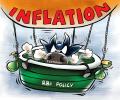
The RBI, which mainly factors in CPI for arriving at its bi-monthly monetary policy, has been mandated by the government to ensure that inflation remains at 4 per cent, with deviation of 2 per cent on either side.

But the ISI chief did not retire giving the impression that he has won General Asim Munir's trust, notes Rana Banerji who headed the Pakistan desk at RA&W.

Chief economist at State Bank of India has revised downward the full-year growth forecast to a low 6.8 per cent from 7.5 per cent earlier for FY2023, citing "the way below GDP numbers for the first quarter". The National Statistical Office on Wednesday released the Q1 growth numbers which showed a consensus growth of 13.5 per cent, pulled down by the poor show of the manufacturing sector, which reported a paltry 4.8 per cent expansion in the first three months of FY23, negating the robust show by the services sector. Consensus forecast was 15-16.7 per cent of which the RBI made the highest forecast of 16.7 per cent.

Industrial production grew 11.9 per cent in August mainly due to a low-base effect and good performance by manufacturing, mining and power sectors that surpassed the pre-COVID level. The manufacturing sector, which constitutes 77.63 per cent of the Index of Industrial Production (IIP), grew 9.7 per cent in August, according to the data released by the National Statistical Office (NSO) on Tuesday. The mining sector output rose 23.6 per cent in August, while power generation increased 16 per cent.

The retail inflation rate breached the 6 per cent upper tolerance limit of the RBI for the first time in seven months in January, while the wholesale price index stayed in double-digits for the 10th month in a row, showed two sets of data released by the government on Monday. Retail inflation, the key input for the RBI while reviewing the repo rate every two months, soared during the month mainly because of a spike in certain food items. The previous high for retail inflation was 6.26 per cent in June 2021.

It is high time to rethink the entire recruitment process for the civil services, the Department-related Parliamentary Standing Committee on Personnel, Public Grievances, Law and Justice opined in its latest report.
